Monday, 10 March 2014

Le Pont du Nord (1981)

  'Le Pont du Nord' is a 1981 French film directed by Jacques Rivette.

  Set on the streets of Paris, Marie an ex-convict, meets Baptise randomly on the streets three times. After this they become friends as "Once is accident, twice is chance, three times is fate". They travel the streets together as they follow a map, which they believe is a conspiracy, stolen from Marie's ex-boyfriend. Baptise has a tendency to stab out the eyes of posters and is a karate expert, but during the film they become good friends.

  'Celine and Julie go Boating' was my last Rivette film, which I hated. I wanted to watch another of his films, as I didn't understand the whole Rivette experience, and he currently has alzheimer's. Part of the late French New Wave, Rivette is a film-maker which critics and pretentious film snobs have been applauding, so when I blind bought this on bluray for a tenner. Even if it's one of his lesser films, it's a vast improvement on 'Celine and Julie go Boating'.

  With Rivette films, there is no way of predicting what may occur. Events occur randomly and have little to do with what happened before. The downfall of this film is that none of it makes any sense. There is a faint thread of a plot, but most of the story and characters I would consider to be 'stupid'. Even at two hours the film feels overlong, and the dialogue is well written, but feels like ramblings pursued by ramblings. This was the main criticism of 'Celine and Julie go Boating', and it's a shame to see it return. It's not all bad...

 Set entirely outside, the gorgeously shot cinematography is the best part of the film. Even if you don't like the film, you can admire 'Le Pont du Nord' purely for it's looks. The 80s set Paris is being half built and half destroyed, with some interesting scenes in 'new' Paris by the Arc de Triomphe and in the 'old' Paris with derelict train tracks. The tall building work well for the film, making Paris seem like a grand and alienating place. The memorable and vivid colour of the sky is due to the whole film being shot during the hours approaching sunset (I assume).

  The film stars Rivette muse Bulle Ogier, and her daughter Pascale Ogier. At the beginning I thought they were lesbians (sleeping on park benches together), an easy mistake to make. What is really tragic, is that Pascale died soon after making the film at the age of 24. For a inane script she acted well and unpretentiously.


TO CONCLUDE
I dislike it as much as I adore it. A memorable, and very strange, journey.

SCORE
67

Sunday, 9 March 2014

Henry V (1944)

  'Henry V' is a 1944 British film directed by and starring Laurence Olivier, taken from the play written by William Shakespeare.

  Henry V has inherited the throne after the death of his father Henry IV. He has a wild and lively reputation, so when the French Prince Dauphin sends Henry an insulting message in response to Henry's claim for French land, he starts a full on war. After the death of Falstaff, Henry and his small army travel to France, where the French large army wait for him.

  I have seen a couple of direct adaptations of Shakespeare's plays, and none of them have surpassed mediocre. Polanski's Macbeth was forgettable, Branagh's Hamlet was long, and Luhrmann's Romeo and Julliet was the movie equivalent of gherkins in a Big Mac. However it didn't help that my English teacher kept replaying the film over and over, I must have seen it five times. The question you are asking yourself now is, Is Henry V the first truly great Shakespeare film adaptation. erm... no.

  Maybe Shakespeare isn't my thing. This being my first Olivier film, I think my hopes were too high, and were inevitably destroyed after the first five minutes. Firstly the positives. For 1944, the film is ahead of it's time, and in colour! It doesn't feel like a 1940s film, which I think is a good thing. Partly due to the cardboard set design and the costumes, which are colourful and different to anything around that time.

  The negative list is quite long. With Shakespeare, the most important thing is the acting, and while most characters were portrayed decently, there was no outstanding performance. With all the hype surrounding Olivier, you can understand my disappointment. He was effective, but I feel Branagh did a superior job in 'Henry V' (1989). Without great performances, Shakespeare adaptations are don't work.

  I know the story of Henry V quite well, but in this version, Olivier managed to bore me to death. The first 25 minutes is set in The Globe, which was dull, and the last 20 minutes was Henry's stupid proposal for a girl he just met, who doesn't speak his language. You get the feeling he is a pimp or a womanizer rather than a great and loving king. My advice? take out the first and last 25 minutes. In the 1989 version, the story builds up to the bloody and brutal war scene. But here, the build-up is slower and the battle is not as satisfying, even if it's the best part of the film.

  The biggest problem of all is the language. They were speaking so fast, I couldn't process what they were saying. Luckily the film has a simple plot, but it felt like I was watching a silent film. The actors were rushing through their lines, there was no time to think about what they were saying.

  I'm sure I'm in the minority with disliking this film. So trusting other reviews is a better idea. A way better idea. One of these days I will find a good direct Shakespeare adaptation.


TO CONCLUDE
137 minutes of boredom. I tried to like it, but from the start, it wanted me to sleep.

SCORE
51

Saturday, 8 March 2014

The Ceremony (1971)

  'The Ceremony' (Gishiki) is a 1971 Japanese film directed by Nagisa Oshima.

  The story covers the many ceremonies held by the Sakurada family from 1945-1971. Each ceremony happens on an important date in Japanese culture, adding to the historical depth of the film. Masuo and his mother arrive from Manchuria, where they had fled, to avoid the repercussions of war. When they get back, the family hold a ceremony to mark a year since Masuo's father's death. Here, it's announced his younger brother had died, so Masuo is expected to live for two sons. Masuo and his cousins hold a baseball match, which 'Future Masuo' remembers fondly. This is where he realizes his feelings for his Aunt Setsuko. Back to present day, where Masuo and his cousin Ritsuko receive a telegram saying Terumichi (also cousin) had commited suicide. They travel to the island to find out the truth. Flashback upon flashback occurs, revealing the family secrets one by one.

  Firstly, this film is tough to keep up with. The story darts back and forwards in time, and there are many different characters. Everything gets confusing, and there are a few things I don't understand even now. When it's revealed Ritsuko and Masuo are brother and sister, is Setsuko his mother? Who's son is Tadashi, the third cousin? And I thought 'The Inugami Family' was complex... These details are minor in the grand scope of the plot. The film is incredibly ambitious, with it's covering significant history of Japan and spanning 25 years.

  The film deals with many subjects, including communism, incest and suicide, but there are many underlying messages as well. It's a film about family control, and an  individual which has to withstand though the entirety of it, through his life. It's a film about how family ceremonies bring out the worst in people and bring up uncomfortable memories from the past. It's a film about Masuo's Oedipul love for his Aunt, and the resounding problems when an individual has no father to aspire to.

  There are four or five funerals and one wedding, during the entirety of the film, so the tone is serious and often depressing. Funerals signify the loss of a loved one, as well as the passing of time, so to have four or five in a single film is purely miserable. Even the wedding is depressing.

  While the story is complex and miserable, it's told flawlessly. This is my first Oshima film, and I, now, intend to see more. The pace of the film never slows down, and even if the flashbacks and story is complex, it definitely makes sense. After watching, you feel like you have seen an epic, like The Godfather, and that you have been taken on a long fantastical journey.


TO CONCLUDE
'Four Funerals and a Wedding'. Expertly told, this is a film I respect more than I love.

SCORE
78

Friday, 7 March 2014

Picnic (1996)

  'Picnic' (Pikunikku) is a 1996 Japanese film directed by Shunji Iwai.

  The story follows 3 members of a mental asylum, Tsumiji, Coco and Satoru, as they escape from the asylum, and into the real world. On the way, they find a vicar, who changes their out-view on life, by giving them a bible. Tsumiji takes interest and starts believing in god, while Coco believes the world began when she was born. While they look around town, they must walk ontop of the fences and walls to avoid the floor. They read in the bible that the world will end on the 10th July, so they roam around town attempting to find the perfect place for a picnic.

  This is my first Iwai film, so I went into this open-minded and was pleasantly surprised. Only lasting 68 minutes, the film is short on time but long on heart. The story is lyrical and original, which is strange as there appears to be no definitive message. The characters are similar to 'I'm a Cyborg, but that's Okay', so this could be seen as a sequel, made before that film. The acting is impressive, making 'Picnic' a perfect character study.

  As the characters are constantly walking across walls, the camera points to the sky whenever filming the three characters. Tsumiji, Coco and Satoru seem to be talking about heaven and hell during the entire film, so the camerawork made me feel like they were taking a trip to heaven. The ground being temptation from the devil, and the wall being the stairway to heaven. This film can be interpreted many ways.

  The soundtrack contains a dizzying piano score, which crescendos with any plot point. It can be seen as irritating or wonderful, depending on how submerged into the film you are.


TO CONCLUDE
'Picnic' is a gorgeous, small budget film, with big ambitions.

SCORE
78

Wednesday, 5 March 2014

TOP 20 FILM ENDINGS

20 of my favourite ending I have seen. Spoilers if you read the description, but if you look at the titles and pictures, they will be less spoiled. The only rule for this list, is that the films are not mainstream Hollywood blockbusters. So 'Fight Club', 'Usual Suspects', 'The Sixth Sense' are out. Now let's start!

----------------------------------------------------------------------------------------------------------------------------------
20


Das Boot
Possibly the most intense film ever made. This German 3 hour film, isn't an easy watch. Towards the end, their submarine is sunk into deep waters. Things are presumed doomed, until the crew manages to fix the submarine, and the submarine is raised. HOORAY, oh wait. When they arrive, the docks get bombed and most of the main characters die.

----------------------------------------------------------------------------------------------------------------------------------
19


Klass
There is nothing that can pay back the time you put into a movie than a high school massacre. The most shocking, unflinching and exploitive way to end a movie. 'Zero Day' is equally as shocking, while 'We Need to Talk about Kevin' includes a massacre without showing it. 'If...' is the first film to touch on the subject and 'Bang, Bang You're Dead' does the opposite and makes you think it will end in a massacre, when it doesn't. As endings go, there isn't anything quite like it.

----------------------------------------------------------------------------------------------------------------------------------
18


Don't Look Now
After a chase scene after someone which they think is their dead daughter, through the streets of Venice. Turns out it's an angry dwarf in a red coat... with a knife...

----------------------------------------------------------------------------------------------------------------------------------
17


Nostalgia
Andrei Tarkovsky's film about a Russian poet travelling through Italy with his wife. The end consists of a long shot of a guy holding a candle, and a scene where a guy sets himself on fire. It's only good if you watch it though...

----------------------------------------------------------------------------------------------------------------------------------
16


Black Orpheus
The retelling of the Orpheus myth in the slums of Rio, during 'Carnival', is a culturally wonderful film, with a sweet ending. After the death of Orpheus, the neighbourhood children gather on the cliff, and play his guitar to make the sun rise. 

----------------------------------------------------------------------------------------------------------------------------------
15


Ballad of Narayama
Both the 1958 and the 1983 versions. The story of a small town by a mountain in 19th Century Japanese village where a tradition states 'on their 70th birthday' the elders of the village are taken by their sons to the top of the mountain, and left their to die. A heart-wrenching drama focusing on how important family is. The ending takes place on top of the mountain.

----------------------------------------------------------------------------------------------------------------------------------
14


Throw Away Your Books and Rally in the Street
This little seen Japanese New Wave film has a strange ending. Similar to the end of 'The Holy Mountain', all of the characters look into screen as the main character recites a speech about how 'the film is not dream or reality, so what am I?' It lasts about five minutes. Then there is another five minute shot of people's faces. The camera takes one continual long pan. Doesn't make much sense unless you watch the film.

----------------------------------------------------------------------------------------------------------------------------------
13


The Sword of Doom/Harakiri
While Harakiri is considerably better, both star Tatsuya Nakadai, and both end in an insane samurai sword fight. I'm talking the 1 vs 50 type.

----------------------------------------------------------------------------------------------------------------------------------
12


Dear Zachary: A Letter to a Son About his Father
The only documentary on the list, is a letter from Kurt Kuenne to his best friend's son, Zachary Bagby, about his father Andrew Bagby. Andrew was murdered by a crazy woman, so Kurt made this film for the crazy woman's son. That means she was pregnant with his baby, when she killed him. It's rare for a documentary to have advancements in the documentary while it was being filmed. It's even rarer for the advancements to be SO DAMN DEVASTATING. Pretty much the crazy woman, killed herself, with zachary. Both dead. Gone. Vamooshed.

----------------------------------------------------------------------------------------------------------------------------------
11


Manon des Sources
The second part to the Jean de Fleurette story and this one is equally as brilliant as the first one. The realization that the hunchback who killed himself is his son, and the girl who hates him more than anyone in the world is his grand-daughter, as well as his nephew committing suicide. It has to be the most depressing ending in cinematic history.

----------------------------------------------------------------------------------------------------------------------------------
10


Les Diaboliques
Henri-Georges Clouzet's mystery masterpiece has a devilishly clever ending. It hints at a highly intelligent second ending. I know I've spoilt every other film on here, but this is one I really don't wan't to. IT'S THAT GOOD.

----------------------------------------------------------------------------------------------------------------------------------
09


The Seventh Seal
How could I not include this on my list. The infamous 'Dance of Death' is a glorious, and crazy way to end. Jof has 'second sight' and tells his wife he can see "they're all there. The blacksmith and Lisa, the knight and Raval J, and the grim master, Death, invites them to dance. He wants them to hold hands and dance in a long line. And the grim master leads with scythe and hourglass. They move away from the dawn, in a solemn dance away to the dark country". His wife replies "You and your dreams and visions".

----------------------------------------------------------------------------------------------------------------------------------
08


Sightseers
"Have you had a good holiday?". Ben Wheatley's darkly comedy, where a husband and wife (Chris and Tina) go on a caravaning holiday and start killing people is definitely to an aquired taste. The last 5 minutes are the only part not in the trailer. After their killing spree, they run to an aquaduct. Chris has had the idea of jumping off it since the begining of the holiday, Tina sort of agrees to it. They are standing on the edge, Chris counts down as they hold hands. He jumps off to a violent and bloody death, while she looks down frozen in shock. Cue to credits with an upbeat Pop cover of 'Tainted Love'

----------------------------------------------------------------------------------------------------------------------------------
07


The Canterbury Tales
This is here purely for the insanity. Pasolini's ending are often crazy, but this is mental. After a meh film, with atrocious dubbing and a scene where Tom Baker gets jerked off, a friar is alone in his bed after two young girls have left. An angel appears from the window and says "You must come with me. We are going to pay a visit to hell". The friar says "Why?", to which the angel replies "Up above they decide to do what they like", "Close your eyes, 1, 2, 3"... They appear walking through hell, with demons raping people one side and people being torchered to the other, and screams through the audio. Satan appears, and the angel tells him "Hey Satan, show him where you keep the friars in hell" he lifts up his tail, and shits them out. Then there's a shot back to Chaucer where he finishes his book, and finally a shot of Canterbury cathedral to finish it off.

----------------------------------------------------------------------------------------------------------------------------------
06


The Human Condition
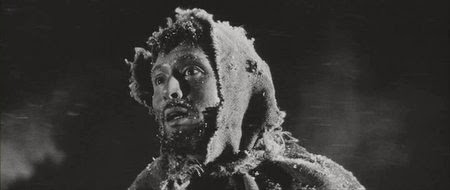
It wouldn't be any kind of a list without my favourite film ever. After escaping the Russian POW camp, he is Running through the cold, snowy wasteland all alone, whispering the name of his lover, which they have been apart for ages. Eventually he dies.

----------------------------------------------------------------------------------------------------------------------------------
05


Excision
That weird movie with the girl who has the fetish about blood has a 'killer' ending. To save her ill sister from dying, she kidnaps both her sister and the girl which lives across the street, and performs surgery on them. The mom comes home to find a tied up father, two dead girls, and her daughter who says "After I successfully retrieved the lung, I practised my incision. You have to take a closer look mum, she's extraordinary". More frightening than Alistair Darling's eyebrows.

----------------------------------------------------------------------------------------------------------------------------------
04


Spoorloos (The Vanishing)
For a mediocre film, this has a hell of an ending. One which kept me awake for ages, and plays on one of our worst fears of being buried alive. 3 years have passed since his wife gets kidnapped at a service station. He gets a letter from the killer, telling him to meet. When they meet, the killer tells him to go on a road trip, and at the end of the road trip he will find out what happened. When they finally arrive at the gas station, the killer tells him "drink this coffee and you'll know what happened to her". Even after knowing there is a sleeping pill in the drink, he is so crazy about finding her, he drinks it. He then wakes up in a coffin.


----------------------------------------------------------------------------------------------------------------------------------
03


8 1/2
Fellini's best loved film, peaks at the ending. Everyone from the director's life appears and dances around a circle, while some circus players play the music. When anyone thinks of anything being Fellini-esque, I automatically think of this one scene and how amazing it is.

----------------------------------------------------------------------------------------------------------------------------------
02


Psycho
The film I thought was boring the first time I saw it, turned into one of my favourite films the second time. Once you know the ending, you spend the film, looking for clues, and analysing the Freudian subtext and gazes. I'm not talking about the 'He wouldn't even harm a fly' scene, but the scene where Lila is looking for somewhere to hide, but goes to the basement. The audience knows that something terrible is down there, but she has no idea. When the corpse swings around and Norman opens the door in his mother's wig, it sends shivers down my neck every time.

----------------------------------------------------------------------------------------------------------------------------------
01


Life is Beautiful
If you don't cry during this, you will never cry. A very sad story about jews in a holcaust camp. Instead of full-on disturbing like Schindler and his list, this film plays on your emotions by a father sacrificing himself for his son. The reunion between the mother and the son is also heart-wrenching.


A Couple of Terrible Endings

Gaav
The guy finds out his cow dies, and falls over and dies INSTANTLY.

Signs
Water? Is that the best ending they could come up with?

Indiana Jones and the Kingdom of the Crystal Skull
Aliens? Is that the best ending they could come up with?

Irreversible
Despite having a couple of brutal, shocking scenes, ending it with her figuring it out she was pregnant is thin ice. Real thin.


Forest of the Fireflies' Light (2011)

  'Forest of the Fireflies' Lights' (Hotarubi no mori) is a 2011 Japanese anime film directed by Takahiro Omori. 

  Hotaru takes a train to her uncle, while remenising on her previous summers in the forest, nearby her uncle's house. When she was young, she got lost in the forest. There she met a spirit with a mask, named Gin, which helps her back to reality. Gin is a ghostly spirit, which is unable to touch humans. Together, over the many summers they meet, share an unforgettable friendship. 

  This is Takahiro's first movie, with a career of directing and animating tv series (including Cowboy Bebop). It's only 45 minutes long, which feels way too short for a film with such a grandiose story, that spans many years. The short running time makes every minute a delight, so viewers with short attention spans will appreciate this most.

  Animations are best when they take the viewer on a journey, unable to work in other film mediums. The beauty of the forest, the glistening of the water and the Japanese Spirits would be void if filmed in real locations with real actors.

  This movie is most notable for the story. How it's told, the idea and the sad, sad ending, make it stand far above mediocrity. Sometimes I felt the story was too manipulating, but when the inevitable occurs in the tear-jerking finale, it makes up for everything. 


TO CONCLUDE
It may lack the visual details of Shinkai, or the classiness of Ghibili, but this is a funny, sad and entertaining yarn.

SCORE
79

Saturday, 1 March 2014

Le Havre (2011)

  'Le Havre' is a 2011 French film directed by Aki Kaurismaki. Even though the director is Finnish, it's set in France and spoken in French, so... I guess its French.

  Marcel Marx is a shoe shiner in Le Havre, Normandy. One day, he meets a small African child (Idrissa), who has recently escaped from a freight container to London. Marcel tries to send Idrissa off to London, but on the way he must deceive an inspector, and cope with a seriously ill wife. His neighbours and friends from the local bar, help him achieve his goal.

  Sounds familiar to the Dardenne Brothers's 'La Promesse' but where that focused on hard hitting drama, this is more a dark comedy with random outbursts of melodrama. In the middle of nowhere, the melodramatic music kicks in, and everything is melodramitified X10. One of the many strange gimmicks this film has. Other gimmicks include: a random rock concert towards the end, which feels completely out of place, the dry wit and a cameo by Jean-Pierre Leaud. That is not all that makes this film unusual...

  What I found strange is the camera angles. Most of them consisted of a medium close-up of one person, facing the camera and looking slightly to the left or right. Most of the other shots consisted of two or three people talking to each other, while not looking at each other, creating a disjointed experience. This is part of Kaurismaki's style and what makes him an auter, so I do like these strange (Ozu-like) shots.

 Despite the film being set in a gorgeous city, Kaurismaki manages to focus on the derelict and the bland instead of the beautiful scenery. I'm not saying the shots are bland, just unusual. The only thing which irritated me was the lighting. Every scene in the film has a massive light shining on the character's forehead. While over-lighting may be fine for photographs, it looks completely out of place here.

  The film is very accessible, and fun to watch. The incredibly happy ending was a disappointment, but overall a fine film.


TO CONCLUDE
Likeable characters, simple plot, dry humour and a very French detective.

SCORE
76