'Conflagration' (Enjo) is a 1958 Japanese film directed by Kon Ichikawa, adapted from the Mishima novel 'Temple of the Golden Pavilion'.
Goichi Mizoguchi returns to the Temple of the Golden Pavillion, that his, now deceased, father was acquainted with. The head priest takes him in, in hope to find a successor. His mother soon arrives to try and help him, but Goichi rejects her, due to her infidelity. Goichi becomes friends with the crippled Tokari, who insists he makes the priest angry.
Kon Ichikawa is one of those directors which I would watch more of his films if they were available. 'Tokyo Olympiad' is one of my most wanted to see films, but the only version I can watch, is a Criterion DVD selling for over $100. In the meantime, I decided to watch this little known film from his golden 1950s classic period, which includes the devastating war films 'The Burmese Harp' and 'Fires on the Plain'.
'Conflagration' is proof that there are amazing films hidden in the depths of Japanese Cinema. It's a film that no-one has ever spoken about, and isn't on any best of film lists (except it's number 124 on the Kinema Junpei's top 200 films, 2009 list). I watched it because it starred Tatsuya Nakadai, Japan's finest actor, and is directed by Kon Ichikawa, a brilliant director from the films I have seen of his. Turns out the film is adapted from a novel by Yukio Mishima, and that I had already seen an adaptation of the story in Schrader's 'Mishima: A Life in Four Chapters'.
The film is riveting and exciting throughout. While watching it, it's clear the film has a tragic atmosphere. It's obvious that something bad will happen, but it's unclear what it is (unless you look up conflagration in a dictionary, which is a spoiler). The feeling of an inevitable disaster is achieved by the protagonist, Goichi, being a misunderstood character, that never does anything good. He treats the stutter as a curse, and refuses to speak due to his embarrassment. Instead of conquering the defect like most films would have ('Like Stars on Earth'), he is tormented and teased until he is, mentally, pushed over the edge ('Klass'). It may not be the only thing that got him into the negative mind-set, but it's the most shocking and hard-hitting. It's like the anti-'The King's Speech' in that aspect.
Goichi is a character which wouldn't prevent something bad happening, but would watch from a distance, a point which Kon Ichikawa shows clearly. His timid and desperate personality is acted authentically by Raizo Ichikawa (no relation to Kon), most known for his acting in the 'Shinobi no Mono' ninja films. Every other character in this film is unsympathetic including Tokari, played by Tatsuya Nakadai, who returns to playing an evil cripple ('Immortal Love'), a role he is flawless at.
The visuals remind me of Kinoshita's 'Immortal Love', where the outdoor scenes are stunning and the indoor scenes are framed well, and have a great use of lighting. The excellent lighting made me notice that Ichikawa has a tendency for sweating characters, especially during the more intense scenes. Despite this, Ichikawa lacks any auteur trademarks, that make Imamura and Oshima masters.
Overall I would definitely recommend watching 'Conflagaration'. It does the opposite of what so many films do ('Red Beard'), and it does it fantastically. Oh yeah, it also features the strangest reaction to a miscarriage in film history.
TO CONCLUDE
Don't be put off by its obscurity, it's a great film from beginning to end.
SCORE
80
Wednesday, 18 June 2014
Tuesday, 10 June 2014
The Silent Duel (1949)
'The Silent Duel' (Shizukanaru ketto) is a 1949 Japanese film directed by Akira Kurosawa and starring Toshiro Mifune and Takeshi Shimura.
Dr Kyoji Fujisaki (Mifune) is a surgeon, operating on soldiers in World War II. He contracts Syphilis from a patient while performing surgery by cutting himself with a knife soaked in the patients blood. There is treatment for the disease, but its close to incurable. Once home and working at his father's clinic, he tries to keep the disease a secret and refuses to tell his long-term girlfriend this. Troubles soon arise as he meets the infected patient he saved during the war.
Akira Kurosawa is definitely the greatest director that has ever lived, directing 30 films throughout his long career. There is an incredible 26 amazing film streak, between 'No Regrets for our Youth' and 'Madadayo', not a single bad film was made in that period. All of those films have above a 7.0 on IMDB (to put that in perspective, Amanda Seyfried only has one film in her filmography with an above 7.0 score), and the 21 films I have seen of them range from good, to phenomenal. His smaller films are bound to be lesser seen, but some of them hold up to the big guns (I think 'Madadayo' is one of his best works). I have all four BFI boxsets, plus the DVD releases of 'The Idiot' and 'Ran', just in case you needed proof of how highly I think of him.
'The Silent Duel' is near the start of his career, after 'Drunken Angel' and before 'Stray Dog'. It stars his two favourite actors, Toshiro Mifune, who has starred in 16 Kurosawa films, and Takeshi Shimura, who has starred in 21 of Kurosawa's films. The film is worth it for their brilliant acting, especially as the scene where they the son confronts the father is the best scene in the film. Their on-screen presence alone makes the film worth a watch.
Kurosawa's directing is (of course) great, with some thrilling tension-building surgery scenes that are edited and framed perfectly. It's surprising to see he has developed some of his best techniques so early on in his career.
The story of the film feels like a condensed 'Red Beard'. The majority of the action is set in a hospital that's not as exciting or beautiful as 'Red Beard', and the story lacks the epic scope Kurosawa is known for. The film plays out as a gripping, and overly melodramatic soap opera, which I got tired with way before the end.
Although the film is far from his best works, it is still a decent and affectionate film.
TO CONCLUDE
Acted and directed by Japan's finest, but disappointingly ordinary.
SCORE
72
Dr Kyoji Fujisaki (Mifune) is a surgeon, operating on soldiers in World War II. He contracts Syphilis from a patient while performing surgery by cutting himself with a knife soaked in the patients blood. There is treatment for the disease, but its close to incurable. Once home and working at his father's clinic, he tries to keep the disease a secret and refuses to tell his long-term girlfriend this. Troubles soon arise as he meets the infected patient he saved during the war.
Akira Kurosawa is definitely the greatest director that has ever lived, directing 30 films throughout his long career. There is an incredible 26 amazing film streak, between 'No Regrets for our Youth' and 'Madadayo', not a single bad film was made in that period. All of those films have above a 7.0 on IMDB (to put that in perspective, Amanda Seyfried only has one film in her filmography with an above 7.0 score), and the 21 films I have seen of them range from good, to phenomenal. His smaller films are bound to be lesser seen, but some of them hold up to the big guns (I think 'Madadayo' is one of his best works). I have all four BFI boxsets, plus the DVD releases of 'The Idiot' and 'Ran', just in case you needed proof of how highly I think of him.
'The Silent Duel' is near the start of his career, after 'Drunken Angel' and before 'Stray Dog'. It stars his two favourite actors, Toshiro Mifune, who has starred in 16 Kurosawa films, and Takeshi Shimura, who has starred in 21 of Kurosawa's films. The film is worth it for their brilliant acting, especially as the scene where they the son confronts the father is the best scene in the film. Their on-screen presence alone makes the film worth a watch.
Kurosawa's directing is (of course) great, with some thrilling tension-building surgery scenes that are edited and framed perfectly. It's surprising to see he has developed some of his best techniques so early on in his career.
The story of the film feels like a condensed 'Red Beard'. The majority of the action is set in a hospital that's not as exciting or beautiful as 'Red Beard', and the story lacks the epic scope Kurosawa is known for. The film plays out as a gripping, and overly melodramatic soap opera, which I got tired with way before the end.
Although the film is far from his best works, it is still a decent and affectionate film.
TO CONCLUDE
Acted and directed by Japan's finest, but disappointingly ordinary.
SCORE
72
Monday, 9 June 2014
The Organizer (1963)
'The Organizer' (I compagni) is a 1963 Italian film directed by Mario Monicelli and starring Marcello Mastroianni.
The factory workers of a small town in Turin, Italy decide to go on strike to obtain better working conditions. They enlist the help of a professor (Mastroianni), who is passing through.
Monicelli is different from other Italian directors, as his films don't focus the crazy and camp (Pasolini, Fellini), or harsh neo-realism (Rossellini), but rather Italian Comedies. They aren't spoof or slapstick, and use a mixture of crazy Italian archetypes, unusual situations (rebelling against authority) and sad endings. 'The Organizer' is a fantastic ensemble comedy, with a large cast and great acting.
The film does feel, partially, like Rossellini's hard-hitting war trilogy, with the truths of poor living conditions shown explicitly. The characters include every Italian stereotype imaginable, including a crazy fat man, ladies with attitude, and loud children. The unflinching realism, matches well with the comedic characters and creates a funny and dramatic film. The narrative is linear and quite predictable, until the shock finale. Monicelli's films rarely end in happiness, so I should have expected the events of the end.
The wonderful characters are acted by some of Italy's finest. Marcello Mastroianni is widely known as Italy's greatest actor (thanks to '8 1/2'), and he appears in films by some of the world's greatest directors including Altman, Angelopoulos, Petri, Visconti and, of course, Fellini. He might be the best aspect of this film. Even his presence in the film elevates it to a high standard. There can't be many actors who can play the part of a fish-out-of-water professor any better. The scene where he gives a speech to persuade the workers to strike longer, sent shivers down my neck. The first time this has happened for a speech scene in a film.
The whole film is a resounding delight, even more enjoyable than 'The Great War'. It takes a while to get into, but when the characters are fully introduced and the professor arrives, the film is mesmerising.
TO CONCLUDE
An unexpected pleasure, that is powerful, funny and acted to perfection.
SCORE
80
The factory workers of a small town in Turin, Italy decide to go on strike to obtain better working conditions. They enlist the help of a professor (Mastroianni), who is passing through.
Monicelli is different from other Italian directors, as his films don't focus the crazy and camp (Pasolini, Fellini), or harsh neo-realism (Rossellini), but rather Italian Comedies. They aren't spoof or slapstick, and use a mixture of crazy Italian archetypes, unusual situations (rebelling against authority) and sad endings. 'The Organizer' is a fantastic ensemble comedy, with a large cast and great acting.
The film does feel, partially, like Rossellini's hard-hitting war trilogy, with the truths of poor living conditions shown explicitly. The characters include every Italian stereotype imaginable, including a crazy fat man, ladies with attitude, and loud children. The unflinching realism, matches well with the comedic characters and creates a funny and dramatic film. The narrative is linear and quite predictable, until the shock finale. Monicelli's films rarely end in happiness, so I should have expected the events of the end.
The wonderful characters are acted by some of Italy's finest. Marcello Mastroianni is widely known as Italy's greatest actor (thanks to '8 1/2'), and he appears in films by some of the world's greatest directors including Altman, Angelopoulos, Petri, Visconti and, of course, Fellini. He might be the best aspect of this film. Even his presence in the film elevates it to a high standard. There can't be many actors who can play the part of a fish-out-of-water professor any better. The scene where he gives a speech to persuade the workers to strike longer, sent shivers down my neck. The first time this has happened for a speech scene in a film.
The whole film is a resounding delight, even more enjoyable than 'The Great War'. It takes a while to get into, but when the characters are fully introduced and the professor arrives, the film is mesmerising.
An unexpected pleasure, that is powerful, funny and acted to perfection.
SCORE
80
Friday, 6 June 2014
The Marquise of O (1976)
'The Marquise of O' (Die Marquise von O...) is a 1976 German film directed by Eric Rohmer.
Set in 1799 Italy, the Marquise of O's father's house is being invaded by Russian forces. She attempts to escape but is caught by Russians and they attempt to rape her. The Count (Bruno Ganz) saves her by scaring them away, and lets her sleep in her bed. The Russian forces surrender and all is well. Until a few months later when the Marquise realizes she is pregnant. After confirmation, the family send her into exile, and the father's identity is investigated.
The final film in the 'Eric Rohmer Collection' (at last!), is completely different from every other film in the collection. You can still tell its a Rohmer film, but everything has changed drastically. The most notable difference is that this is a period film set in the 18th Century. Clothes, props and locations are all suited to that time period, eliminating the fashion atrocities present in his other films. All these things add to the mise-en-scene, giving the film an entirely different feeling. This also effects the cinematography, which is tinged brown giving this film a old quality to it. It's more interesting visually then the majority of Rohmer films, but its still not that great.
The plot develops very slowly. The first ten minutes is action packed during the invasion of the citadel, but the pace slows immediately afterwards. The story itself is similar, as the beginning is exciting while the rest of the film never surpasses dull. Rohmer promises us edge of your seat action, and delivers bland talking and sobbing. The film revolves around a "Who's the father?" conundrum, when it's obvious who the father is from the first 20 minutes. There is only one male character which isn't a family member of the Marquise, so it's bound to be him. The Whodunnit lasts until the last 10 minutes, where the expected is revealed. I'm not sure if it's because I have been watching an abundance of 'Game of Thrones' and 'True Detective' lately, but I found the whole film absolutely boring.
The acting is to a good quality, with a film-stealing performance from Bruno Ganz (Adolf Hitler in 'Downfall') and some very sobby acting from Edith Clever (Die Marquise). I'm not sure why the film is a German production (perhaps the French got bored of him), but it sort of lends itself to the film. In his French films, the characters talk about love in the typical French way, but there is none of that here. There isn't any talking about boring relationships in bedrooms and there is no trips to cafes with secret lovers. It's a side of Rohmer I have never seen before, or even knew existed, but I can't say it's revolutionary or even moderately exciting.
The film has a unique and confusing premise, which is: they are Russians, speaking German and living in Italy. The film is directed by a Frenchman, and I watched the whole thing with English subtitles. The film is possible with the help of five countries! Sad to say this is the film's greatest achievement.
TO CONCLUDE
Very different from anything else I have seen from Rohmer, but the story is a bit rubbish, the pace is slow and the whole film is resoundingly dull.
SCORE
62
Set in 1799 Italy, the Marquise of O's father's house is being invaded by Russian forces. She attempts to escape but is caught by Russians and they attempt to rape her. The Count (Bruno Ganz) saves her by scaring them away, and lets her sleep in her bed. The Russian forces surrender and all is well. Until a few months later when the Marquise realizes she is pregnant. After confirmation, the family send her into exile, and the father's identity is investigated.
The final film in the 'Eric Rohmer Collection' (at last!), is completely different from every other film in the collection. You can still tell its a Rohmer film, but everything has changed drastically. The most notable difference is that this is a period film set in the 18th Century. Clothes, props and locations are all suited to that time period, eliminating the fashion atrocities present in his other films. All these things add to the mise-en-scene, giving the film an entirely different feeling. This also effects the cinematography, which is tinged brown giving this film a old quality to it. It's more interesting visually then the majority of Rohmer films, but its still not that great.
The plot develops very slowly. The first ten minutes is action packed during the invasion of the citadel, but the pace slows immediately afterwards. The story itself is similar, as the beginning is exciting while the rest of the film never surpasses dull. Rohmer promises us edge of your seat action, and delivers bland talking and sobbing. The film revolves around a "Who's the father?" conundrum, when it's obvious who the father is from the first 20 minutes. There is only one male character which isn't a family member of the Marquise, so it's bound to be him. The Whodunnit lasts until the last 10 minutes, where the expected is revealed. I'm not sure if it's because I have been watching an abundance of 'Game of Thrones' and 'True Detective' lately, but I found the whole film absolutely boring.
The acting is to a good quality, with a film-stealing performance from Bruno Ganz (Adolf Hitler in 'Downfall') and some very sobby acting from Edith Clever (Die Marquise). I'm not sure why the film is a German production (perhaps the French got bored of him), but it sort of lends itself to the film. In his French films, the characters talk about love in the typical French way, but there is none of that here. There isn't any talking about boring relationships in bedrooms and there is no trips to cafes with secret lovers. It's a side of Rohmer I have never seen before, or even knew existed, but I can't say it's revolutionary or even moderately exciting.
The film has a unique and confusing premise, which is: they are Russians, speaking German and living in Italy. The film is directed by a Frenchman, and I watched the whole thing with English subtitles. The film is possible with the help of five countries! Sad to say this is the film's greatest achievement.
TO CONCLUDE
Very different from anything else I have seen from Rohmer, but the story is a bit rubbish, the pace is slow and the whole film is resoundingly dull.
SCORE
62
Thursday, 5 June 2014
Vive L'Amour (1994) and What Time is It Over There? (2001)
'Vive L'Amour' (Ai qing wan sui) and 'What Time is it Over There?' (Ni na bian ji dian) are 1994 and 2001 Taiwanese films directed by Tsai Ming-Liang. I decided to review them both together for a change.
'Vive L'Amour' is about three separate characters whose lives unexpectedly meet in an unsold apartment. May-Lin is the estate agent, Ah-Jung is the guy she unexpectedly has sex with, and Hsiao-Kang is the salesman who is living in the apartment (unknown to them).
In 'What Time is it Over There?', A watch seller, Hsiao-Kang, is trying to come to terms with his father's death. His mother is becoming increasingly insane, so he tries to spend as much time as possible out of the house. He sells Shiang-chyi his watch, and has the urge to change every clock he sees to CEST (the time in Paris). Meanwhile Shiang-chyi travels to Paris and befriends a girl.
To celebrate buying a new region free Bluray and DVD player, I decided to start watching Ming-Liang's films on region 1 discs. Taiwan seems to be one of the best countries for films, with master directors Hou Hsiao-Hsien and Edward Yang making films there. Ming-Liang is very critically acclaimed, but I did know his films were different from Hsiao-Hsien's and Yang's works. From watching the segment of Ming-Liang in 'A Story of Film: An Odyssey', I learnt that he believes in the most pretentious saying "If you drink, you must piss or cry". So his films contain lots of drinking, lots of pissing and lots of crying. If you see someone drink in one of his films, you could play the "Will he piss or cry? game". Seeing someone piss on screen is the least cinematic thing ever. It shows how his films encapsulates everyday life, without removing the toilet stuff, to create a realistic portrayal of society. You probably never thought The Terminator took a piss several times during the plotline of each of the films, but I'm going to be honest here, no-one really cares. Seriously Ming-Liang, removing the "man pissing in bottle" scene in 'What Time is it Over There?' or "Lady sits on toilet scene" in 'Vive L'Amour' would improve the films significantly. There is no plot or character development in these scenes, so they are pointless and disgusting.
Something Ming-Liang did use from the Yang and Hsiao-Hsien films was the long take. When I heard about the term "long take" for the first time, I thought how boring they must be, and how no cuts would irritate me. Films like 'The Travelling Players', 'A City of Sadness' and 'Berlin Alexanderplatz' immediately disproved this idea and I now adore the brilliance of the long take. However, Ming-Liang's long takes seems to return to my pre-conceptions. The shots may be composited nicely and use artificial lights impressively, but the long duration emphasizes the fact that nothing happens on-screen whatsoever. They are not so much boring, as tedious and annoying. So little happens in them, I could have fast forwarded x2 the entire films and missed nothing. Character's rarely speak to each other and spend most of the runtime in beds crying, sleeping or walking through vacant corridors and rooms. I'm sure Ming-Liang would think me writing this review on a laptop alone in my room, would be high quality entertainment. Well, it's not.
Ming-Liang is not afraid to show the gritty depressing realism of life. In 'Vive L'Amour' there is a scene where the young salesman attempts to slit his wrists. There's another scene where the insurance saleslady cries for 10 minutes (a painfully long take). Both films contain sprinklings of very bleak comedy, most notably in 'What Time is it Over There?', which contains some genuinely laugh out loud moments. The long duration and the seriousness of the scenes, are mismatched with some subtle neo-slapstick.
I found 'What Time is it Over There?' the better film, because of the improved visuals and the superior story. The film deals with death and the constant expiration of time, as well as featuring a legendary cameo. 'Vive L'Amour' is an earlier film, but is far duller and way more irritating. The story weaves in and out of the three protagonists lives, based around the one apartment where neither of them (legally) live. There is impressive acting from Yang Kuei-Mei (May Lin), and the film is filled with bizarre and unexpected moments, but the the film never gels together.
TO CONCLUDE
I admire the beauty, but the film is painfully slow. I was uninterested for the entirety of the running time.
SCORE
65
TO CONCLUDE
Equally as slow as the previous Ming-Liang, but is a much more interesting, funny and watchable film. Although it's still not enjoyable.
SCORE
69
'Vive L'Amour' is about three separate characters whose lives unexpectedly meet in an unsold apartment. May-Lin is the estate agent, Ah-Jung is the guy she unexpectedly has sex with, and Hsiao-Kang is the salesman who is living in the apartment (unknown to them).
In 'What Time is it Over There?', A watch seller, Hsiao-Kang, is trying to come to terms with his father's death. His mother is becoming increasingly insane, so he tries to spend as much time as possible out of the house. He sells Shiang-chyi his watch, and has the urge to change every clock he sees to CEST (the time in Paris). Meanwhile Shiang-chyi travels to Paris and befriends a girl.
To celebrate buying a new region free Bluray and DVD player, I decided to start watching Ming-Liang's films on region 1 discs. Taiwan seems to be one of the best countries for films, with master directors Hou Hsiao-Hsien and Edward Yang making films there. Ming-Liang is very critically acclaimed, but I did know his films were different from Hsiao-Hsien's and Yang's works. From watching the segment of Ming-Liang in 'A Story of Film: An Odyssey', I learnt that he believes in the most pretentious saying "If you drink, you must piss or cry". So his films contain lots of drinking, lots of pissing and lots of crying. If you see someone drink in one of his films, you could play the "Will he piss or cry? game". Seeing someone piss on screen is the least cinematic thing ever. It shows how his films encapsulates everyday life, without removing the toilet stuff, to create a realistic portrayal of society. You probably never thought The Terminator took a piss several times during the plotline of each of the films, but I'm going to be honest here, no-one really cares. Seriously Ming-Liang, removing the "man pissing in bottle" scene in 'What Time is it Over There?' or "Lady sits on toilet scene" in 'Vive L'Amour' would improve the films significantly. There is no plot or character development in these scenes, so they are pointless and disgusting.
Something Ming-Liang did use from the Yang and Hsiao-Hsien films was the long take. When I heard about the term "long take" for the first time, I thought how boring they must be, and how no cuts would irritate me. Films like 'The Travelling Players', 'A City of Sadness' and 'Berlin Alexanderplatz' immediately disproved this idea and I now adore the brilliance of the long take. However, Ming-Liang's long takes seems to return to my pre-conceptions. The shots may be composited nicely and use artificial lights impressively, but the long duration emphasizes the fact that nothing happens on-screen whatsoever. They are not so much boring, as tedious and annoying. So little happens in them, I could have fast forwarded x2 the entire films and missed nothing. Character's rarely speak to each other and spend most of the runtime in beds crying, sleeping or walking through vacant corridors and rooms. I'm sure Ming-Liang would think me writing this review on a laptop alone in my room, would be high quality entertainment. Well, it's not.
Ming-Liang is not afraid to show the gritty depressing realism of life. In 'Vive L'Amour' there is a scene where the young salesman attempts to slit his wrists. There's another scene where the insurance saleslady cries for 10 minutes (a painfully long take). Both films contain sprinklings of very bleak comedy, most notably in 'What Time is it Over There?', which contains some genuinely laugh out loud moments. The long duration and the seriousness of the scenes, are mismatched with some subtle neo-slapstick.
I found 'What Time is it Over There?' the better film, because of the improved visuals and the superior story. The film deals with death and the constant expiration of time, as well as featuring a legendary cameo. 'Vive L'Amour' is an earlier film, but is far duller and way more irritating. The story weaves in and out of the three protagonists lives, based around the one apartment where neither of them (legally) live. There is impressive acting from Yang Kuei-Mei (May Lin), and the film is filled with bizarre and unexpected moments, but the the film never gels together.
Vive L'Amour
TO CONCLUDE
I admire the beauty, but the film is painfully slow. I was uninterested for the entirety of the running time.
SCORE
65
What Time is it Over There?
Equally as slow as the previous Ming-Liang, but is a much more interesting, funny and watchable film. Although it's still not enjoyable.
SCORE
69
Tuesday, 3 June 2014
Padre Padrone (1977)
'Padre Padrone' (Father and Master) is a 1977 Italian film directed by Paolo Taviani and Vittorio Taviani. It won the Palme D'Or and is based on the life of Gavino Ledda.
In Sardinia, a father storms into his son's classroom, demanding that he stays at home to look after the herd. He reluctantly agrees, and is forced to life as a uneducated Shepard, constantly being bossed around and beaten by his father. The story skips to when Gavino is now 20 years old. He attempts to leave for Germany, but his father refuses to sign the form. Eventually he is enrolled into the army, where he is taught education and the wonders of classical music.
The Taviani brothers have an impressive repertoire of work, ranging from 1970 to present day. They directed 'Kaos', a film my dad insists I watch, and the emotional Epic 'The Night of San Lorenzo'. This is the first film I have seen of theirs, and it's not what I expected. The synopsis above, makes the film sound like a neorealist Rossellini film, which it is... Sort of...
The film does indeed start off as a neo-realist film, with the father storming into the classroom and taking the child away, but as the film progresses, it starts to look more and more like a Pasolini film. It first became visible from the running around the tent, but was confirmed with the sheep milking and the farting. It's completely bizarre to combine the seriousness of child abuse, with the farcical humour of Pasolini and Fellini.
The film is based on the life of author Gavino Ledda, and he actually appears introducing and concluding the film. After introducing the film, the camera tilts up to show the father about to enter the classroom. The real-life Gavino walks up to the father and hands him the stick saying "my father had this as well". This was my favourite moment in the film, as he purposely breaks the forth wall, for no reason at all. It's genius while simultaneously being pointless. This isn't the only experimenting done in the film, there is a scene where the child Gavino, talks to a sheep in his mind. Another where Gavino is sitting on a hilltop playing the accordion, when white writing appears on screen. I always like experimenting in films ('Hausu'), but it doesn't match the tone of despair which is apparent throughout the runtime. Neo-realist and farcical really do not mix well, and that is the film's downfall.
Everything else, from the barren cinematography to the typical Italian acting is great. The film feels like an Epic, spanning 13 years, and deals with many subjects (including bestiality), so it is deserving of the Palme D'Or.
TO CONCLUDE
Not what I was expecting. The strange atmosphere works in some situations but not others. I feel very mixed, but I would say it's worth watching, just for how bizarre it is.
SCORE
71
In Sardinia, a father storms into his son's classroom, demanding that he stays at home to look after the herd. He reluctantly agrees, and is forced to life as a uneducated Shepard, constantly being bossed around and beaten by his father. The story skips to when Gavino is now 20 years old. He attempts to leave for Germany, but his father refuses to sign the form. Eventually he is enrolled into the army, where he is taught education and the wonders of classical music.
The Taviani brothers have an impressive repertoire of work, ranging from 1970 to present day. They directed 'Kaos', a film my dad insists I watch, and the emotional Epic 'The Night of San Lorenzo'. This is the first film I have seen of theirs, and it's not what I expected. The synopsis above, makes the film sound like a neorealist Rossellini film, which it is... Sort of...
The film does indeed start off as a neo-realist film, with the father storming into the classroom and taking the child away, but as the film progresses, it starts to look more and more like a Pasolini film. It first became visible from the running around the tent, but was confirmed with the sheep milking and the farting. It's completely bizarre to combine the seriousness of child abuse, with the farcical humour of Pasolini and Fellini.
The film is based on the life of author Gavino Ledda, and he actually appears introducing and concluding the film. After introducing the film, the camera tilts up to show the father about to enter the classroom. The real-life Gavino walks up to the father and hands him the stick saying "my father had this as well". This was my favourite moment in the film, as he purposely breaks the forth wall, for no reason at all. It's genius while simultaneously being pointless. This isn't the only experimenting done in the film, there is a scene where the child Gavino, talks to a sheep in his mind. Another where Gavino is sitting on a hilltop playing the accordion, when white writing appears on screen. I always like experimenting in films ('Hausu'), but it doesn't match the tone of despair which is apparent throughout the runtime. Neo-realist and farcical really do not mix well, and that is the film's downfall.
Everything else, from the barren cinematography to the typical Italian acting is great. The film feels like an Epic, spanning 13 years, and deals with many subjects (including bestiality), so it is deserving of the Palme D'Or.
TO CONCLUDE
Not what I was expecting. The strange atmosphere works in some situations but not others. I feel very mixed, but I would say it's worth watching, just for how bizarre it is.
SCORE
71
Cinematographer Analysis-Sacha Vierny
Please note that the following was submitted for a university assignment. I got 68/100 (two marks from a first), which helped me make up for my awful marks for E-Business and Human Resource Management (44 and 41). While researching about Sacha Vierny on the internet, there was only one or two articles, so I decided this was good enough to post as he is a remarkable cinematographer that needs more recognition. There is a reason I chose him as oppose to the fifty, or so, more recognisable cinematographers and thats because the visuals in every one of his films is flawless. Without further ado, here it is:
Cinematographer Analysis-Sacha Vierny
For
Cinematography Assignment 2, I had to “research the work of a particular
cinematographer and produce a study that analyses the working practices and key
aspects of the cinematographer’s style”. The cinematographer I chose was Sacha
Vierny. Throughout his career, he worked briefly with Luis Bunuel, Agnes Varda,
although his main collaborators were Alain Resnais and Peter Greenaway. He
directed films with critically acclaimed and avant-garde film directors,
purposely to stay away from the Hollywood mainstream. He has a tremendous love
of his work, and is notable for his dark lighting and his experimentation with
styles. He experiments with all of his films, using improvised techniques and
styles. ‘Hiroshima Mon Amour’ is his first notable feature length film, and his
first collaboration with Alain Resnais. However, their most iconic
collaboration would be on ‘Last Year in Marienbad’ in 1961.
(Figure
1, Last Year in Marienbad, 1961)
This
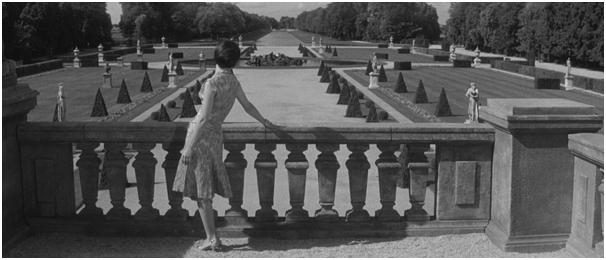
screenshot is taken from Vierny’s second film with Resnais titled ‘Last Year at
Marienbad’. After ‘Hiroshima mon Amour’, Resnais was an established auteur,
with an ambition to experiment. His films include scattered narratives, a plot
equivalent to a puzzle, and a mixture of dreams and reality. Vierny had to
convey all of this in the cinematography. The first aspect which is notable
from the image above is the depth of field. Resnais (2001) said “he was using
auxiliary lenses to get more depth of field than would have otherwise been
possible”. Vierney used auxiliary lenses to increase the depth of field far above
the standard for the industry, creating shots where the character is in focus
in the foreground, while the sculptures and trees are in focus in the
background. As unusual as this technique is, it adds to the dream-like
aesthetic of the film.
The shot
doesn’t look realistic, with the strange shaped trees and the endless path. More
of a sketch than a camera shot. What adds to the abstract of the shot was the
decision to shoot black and white. This was not a budgetary decision, but an
artistic vision as Freeman (2007) states “black and white allows more
expression in the modulation of tone in contemporary texture, the modelling of
form and defining shape”. The texture and detail of the inside of the Baroque
mansion, and the vast gardens would be invalid in colour. Black and white was
used between 1900s-1950s, and induces nostalgia into the viewer. The past and
distant memories are what ‘Last Year in Marienbad’ is all about.
Over-exposure is another technique Vierny used in ‘Last Year in
Marienbad’. The bright white colours add to the mise-en-scene of the film.
“In
style Marienbad is finely appropriate to its context. The use of over exposure,
rapid cutting to break down the normal temporal order and to juxtapose related
scenes and gestures, are obvious and quite literal representations of the
activities of memory, particularly its associative functions”
(Ward,1968)
The unconscious memory differs
from real life in many ways. Altering the exposure of the film, creates an
unrealistic and uncomfortable atmosphere, which is perfect for a film like ‘Last
Year in Marienbad’ due to the obscure narrative and the unclear remembering
structure of the script.
Combining
the lighting with the staging creates a distinct uncomfortable atmosphere. Sutton (2009) agrees with this and says “Vierny and Resnais manage to exploit
the flatness of photography on-screen, using careful techniques of staging and
foreshortening as well as exquisite lighting and sensitive film stock”. The
film has a style copied by films like Stanley Kubrick’s ‘The Shining’ and music
videos like Blur’s ‘To the End’.
(Figure
2, A Zed and Two Noughts, 1986)
In 1986,
Vierny worked on his first film with Peter Greenaway, A Zed and Two Noughts.
From the first shot, Vierny presents many of the techniques he would use in the
next sixteen years, with Greenaway, his second major collaborator. The shots
are planned before recording, and symmetry is an important aspect. The letters
‘Z’, ‘O’ and ‘O’ consume precisely equal amounts of the frame, with vertical
pillars dividing through each letter. The composition of their work is filled with
shots of the subject being in the centre of the frame, with a prop, or an actor
further back to the far left or right. The four intersections that the Rule of
Thirds create, land exactly on the centre ‘O’. Despite this being a well
composited shot, I feel there is too much for the viewer to look at. The
spectator’s eye is not drawn to a specific part of the shot, but all of it so
the spectator can choose where to look on screen.
Greenaway
and Vierny experimented with many different light sources during the filming of
A Zed and Two Noughts. Greenaway (2003) spoke about this and stated “We [Vierny
and Greenaway] played games with the notion of light, about its source and how
it works. We sat down and made a list of 26 different ways we could light a
set”. All 26 methods of lighting are visible in A Zed and Two Noughts, which
ranged from bonfires, candles and cathode-ray tubes to heat cameras and a
rainbow. During the film, they experimented with natural, artificial,
contemporary and industrial light sources that resulted in a distinct and
unusual effect that strengthens the core ideas of the film. The film feels
unnatural and fake due to the natural world being vacant from his films.
Lawrence (1997) compares him to Resnais on this factor and says “As much a
romantic in his way as Resnais, Greenaway persists in the hope for a natural
world. Behind this death, evil and mediocrity is the natural landscape. The
desire to believe reinforced by the knowledge that such a thing does not
exist”. The characters are trapped in an
artificial and claustrophobic prison, which Vierny and Greenaway both created.
“The
cinema is routed, as it is in photography, tends heavily toward illusionistic
realism, and the allegorical material Greenaway includes usually proves
disruptive to the viewer’s illusion that a meaningful world is unfolding”.
(Willoquet-Maricondi,
2001)
The material
and the atmosphere create an illusion that the characters are living in a dream
grounded in reality, similar to Resnais’s ‘Last Year in Marienbad’. The illusion
continued in all of Greenaway and Vierny collaborations.
(Figure
3, The Baby of Macon, 1993)
Many of
Greenaway and Vierny collaborations include the colour red. None of them more
than ‘The Baby of Macon’, which has the colour red in nearly every shot whether
in the foreground, background or costumes. The storyline chronicles the life of
a baby who is believed to be the messiah, but human greed and corruption
exploits the baby. Greenaway’s aim
appears to be to offend, with detestable characters, exploitive violence and a
director who insists on breaking the forth wall constantly throughout. What
Vierny does to support this aim, is to inject the majority of shots with the
colour red and to not include a single close-up in the whole film. Greenaway’s
intention of reminding the audience that the characters are acting in a play on
stage is apparent with scenes including the play’s audience, and even scenes
where they interact with the play. Vierny’s excess of medium to long shots
reminds the viewer they are looking at a distance, similar to a play, rather
than a film.
(Figure 4, The Cook, the Thief, his Wife and her
Lover, 1989) (Figure 5, Samson Le Mariage Et L
Enigme,dresde 1638, Rembrandt)
(Figure 6, The
Draughtsman’s Contract, 1982)
(Figure
7, The Night’s Watch, 1642, Rembrandt)
(Figure
8, The Baby of Macon, 1993) (Figure 9, Danae, 1636, Rembrandt)
The films Vierny and
Greenaway collaborated on in the 1980s-90s were visually inspired by the
paintings of Rembrandt. Shown above, are comparisons between Rembrandt’s
paintings in Greenaway/Vierny’s films, whether it is the framing of the top image,
the costumes of the middle image or the tones and colours of the bottom image.
Their films feel like, they were made in the seventeenth century. Vierny’s
early style was similar, with the architecture in ‘Last Year at Marienbad’
being Baroque, but lacked the dark colours and the Rembrandt style of his
Greenaway work. He has evolved stylistically during the 46 years of making
films.
All of
Vierny’s work is concerned with experimenting with colour and lighting. Whether
this is the control of the black and white and overexposure used in Resnais’s
‘Last Year in Marienbad’, or the large amount of different light sources used
in Greenaway’s ‘A Zed and Two Noughts’.
His style has improved and differed over the decades, but he has always
experimented with every one of his films.
Bibliography
Alain Resnais (October, 2001). ‘The Elegance of Sacha Vierny’ in ‘Positif’.
Issue 488, page 44. Accessed on 25/03/2014.
Amy Lawrence, 1997. ‘Chapter 2’ in ‘The Films of
Peter Greenaway’ pg62. Accessed on 24/04/2014.
Damian Sutton (2009). ‘Cinema’s Photographic View’
in ‘Photography, Cinema, Memory: The
Crystal Image of Time’. Page 127. Available at http://books.google.co.uk/books?id=mhBic-4p3WUC&pg=PA127&lpg=PA127&dq=sacha+vierny&source=bl&ots=TxHMno82V_&sig=nZrXdPadAO3il9pEs4WOG_4NUHs&hl=en&sa=X&ei=iMIsU_qWFseJ0AXlqYC4DA&ved=0CKsBEOgBMBE4KA#v=onepage&q=sacha%20vierny&f=false. Accessed on 21/03/2014.
Figure 1. Last Year in
Marienbad (1961). From: Studio Canal. Directed by Alain Resnais. [film still].
Accessed on 24/04/2014.
Figure 2. A Zed and Two
Noughts (1986). From ........... Directed by Peter Greenaway. [film still].
Accessed on 20/04/2014.
Figure 3. The Baby of
Macon (1993). From Allarts. Directed by Peter Greenaway. [film still]. Accessed
on 12/04/2014.
Figure 4. The Cook, the
Thief, his Wife and her Lover (1989). From Vendex. Directed by Peter Greenaway.
[film still]. Accessed on 25/04/2014.
Figure 5. Samson Le
Mariage Et L Enigme, dresde (1638). Painted by Rembrandt Harmenszoon van
Rijn. Accessed on 13/04/2014.
Figure 6. The Draughtsman’s
Contract (1982). From British Film Institute/Channel 4. Directed by Peter
Greenaway. [film still]. Accessed on 25/04/2014.
Figure 7. The Night’s
Watch (1642). Painted by Rembrandt Harmenszoon van Rijn. Accessed on
13/04/2014.
Figure 8. The Baby of
Macon (1993). From Allarts. Directed by Peter Greenaway. [film still]. Accessed
on 12/04/2014.
Figure 9. Danae, (1636). Painted
by Rembrandt Harmenszoon van Rijn. Accessed on 13/04/2014
John Ward, 1968. ‘L’Annee derniere a Marienbad’ in
‘Alain Resnais on the Theme of Time’ pg57. Accessed on 14/04/2014.
Michael Freeman, 2007. ‘Composing with Light and
Colour’ in ‘The Photographer’s Eye’ pg126. Accessed on 24/04/2014.
Paula Willoquet-Maricondi, 2001. ‘Z is for Zebra,
Zoo, Zed and Zygote’ in ‘Peter Greenaway’s Post Modern/Post Structuralist
Cinema’ pg163. Accessed on 14/04/2014.
Peter Greenaway, 2003,
‘Two Noughts- An Introduction by Peter Greenaway’ on ‘A Zed and Two Noughts’,
dvd, BFI, Stephen Street, London. Accessed on 29/03/2014.
Subscribe to:
Posts (Atom)